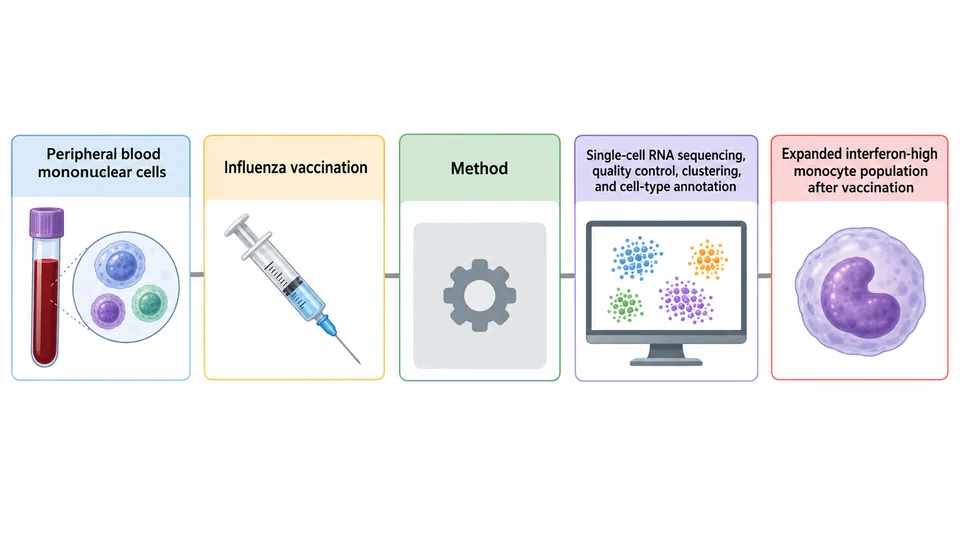
Write a four-part research brief first
Before designing, write one sentence each for the question, approach, main result, and supported implication. This becomes an accountable content boundary for the graphical abstract and its AI prompt.
Extract the central claim
Read the title, abstract, primary figure, and conclusion together. Identify the one result the authors would want a reader to remember, then trace it back to the question and measurement that support it.
Do not combine every secondary analysis or exploratory observation. If the paper has several independent messages, choose one for the graphical abstract or use a carefully grouped summary rather than a long chain.
Match the layout to the paper
Use a workflow for sequential methods, a mechanism layout for interactions, a comparison for matched conditions, and a summary composition when one central finding connects several supporting observations.
Translate repeated entities into consistent visual symbols. Keep experimental input, model prediction, measured observation, and author interpretation visually distinct.
Validate against the manuscript
Compare every label and visual relationship with the source text. Confirm that arrows do not imply causality where the paper reports association and that comparative size or color does not invent an effect magnitude.
Ask a co-author or subject expert to review the visual without your explanation. Their interpretation reveals where the reading order, terminology, or scientific boundary still needs revision.
Four lines to extract from the paper
Keep these lines close to the manuscript wording before turning them into visual instructions.
What specific gap, condition, system, or comparison did the paper investigate?
Which sample, intervention, model, or measurement is essential to interpret the result?
What was directly measured or observed as the principal finding?
What conclusion is supported without extending beyond the study design?
Validate the graphical abstract against the paper
The manuscript remains the authority; the generated image is a draft to review.